
Audience Strategy Built on Real-World Data, Not Digital Tracking
Table of Contents
- 1. The Reset: Marketing After Cookies
- 2. Introducing Household Intelligence
- 3. One Audience Definition, Every Channel
- 4. From Insight to Activation
- 5. Where Household Data Fits
- 6. Planning for Real Demand
1. The Reset: Marketing After Cookies
Marketers don’t lack data. They lack data that shows who actually has a need for what they’re selling.
The industry has built targeting around intent signals: clicks, searches, site visits, browsing behaviour. If someone searches for a product category, the assumption is they’re in-market and ready to decide.
The problem is that intent signals don’t tell you whether someone can actually buy. They capture curiosity, research, and aspiration, not durable demand. When targeting strategies are built on them alone, spend gets wasted on audiences who were never in a position to purchase. That problem compounds when marketers try to follow those signals across channels, stitching together fragmented identifiers in the process.
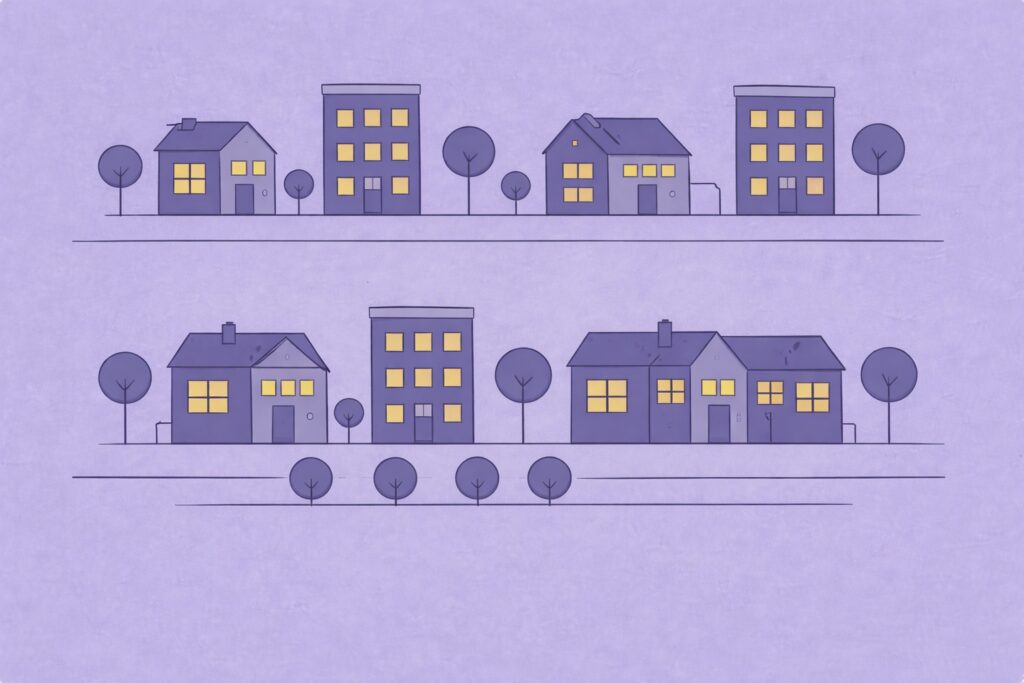
Household data offers a different foundation. Built from public records, official statistics, and geospatial indicators, it reflects how populations actually live, at the household and neighbourhood level, without identifying individuals or relying on tracking.

2. Introducing Household Intelligence
Household Intelligence is a way of understanding demand across the full market, built from public records, official statistics, and geospatial indicators. It models how populations live at the household and neighbourhood level, without identifying individuals or relying on tracking.
People buy based on what their situation requires. And those requirements are often stable over time.
A homeowner needs furniture, insurance, and maintenance for years. A parent needs children’s products across multiple life stages. These needs aren’t defined by clicks. They’re defined by real-world conditions.
Household characteristics act as reliable indicators of that demand. If the underlying need doesn’t exist, a purchase is unlikely, regardless of how much interest is shown online.
Consider someone researching solar panels. They may compare prices, read reviews, and spend hours evaluating options. But if they live in a rental apartment, they’re not in a position to buy. The signal suggests intent. The household reality doesn’t support it. When that person later becomes a homeowner, the need becomes real. For a solar provider, that shift in household context is what determines whether an impression is wasted or warranted.
The same logic applies across categories. Someone buying a baby shower gift may look identical to a new parent in behavioural data, both browse the same products. But only one represents long-term demand. For a children’s brand, the difference matters: one is a single transaction, the other is years of repeat purchases. Behavioural signals struggle to distinguish between the two. Household context does it reliably.
How it’s built
Household data is modelled at the neighbourhood level, grouping areas into cohorts of minimum 100 and up to 500 similar households. Because it draws from publicly available, non-personal sources rather than tracking, it reflects nearly the entire population, not just the users a platform can identify with cookies or device IDs. Audiences can be defined by life stage, homeownership, income, family composition, and other structural characteristics, then applied consistently across channels for both targeting and measurement.
This is also where intent signals become more useful. A neighbourhood of young professionals is more likely to respond to travel and entertainment offers. A family-dense area is more likely to respond to household goods and childcare products. High-income households are more likely to engage with premium offerings. Layering household context onto intent signals lets marketers prioritise audiences most likely to convert, reducing spend on signals that reflect aspiration rather than need.
3. One Audience Definition, Every Channel
Most audience strategies break the moment you change screens.
Cookie-based segments work on desktop display but disappear in mobile apps. Device IDs work in-app but not on the open web. CTV has its own identifiers entirely. Every channel ends up with its own audience taxonomy, its own targeting logic, and its own reporting, and marketers are left stitching systems together and hoping the pieces line up.
Because household data isn’t tied to cookies, device IDs, or individual identifiers, it isn’t confined to any one environment. The same household cohorts can be activated anywhere media runs: display, mobile web, in-app, video, and connected TV. That consistency matters most in environments where identity breaks down: CTV, Safari, iOS, and in-app.
No channel-specific data to reconcile. No identity graphs to maintain. No match rates to lose along the way. One audience taxonomy that works everywhere, and because it’s built at the household level rather than the device level, it also reduces duplication when the same household is reachable across multiple screens.
4. From Insight to Activation
Household data isn’t just a targeting input. It works as an intelligence layer across the entire campaign lifecycle, from understanding who your best customers are, through planning and activation, to measurement.
Understanding your audience
It starts with analysing the household characteristics of existing site visitors and converters. That analysis surfaces the traits that consistently appear among high-value customers: life stage, homeownership, income range, family status. Instead of building personas from assumptions, you build them from real outcomes.
Planning
That profile informs planning. Because household data reflects the full market, audiences can be sized accurately, located geographically, and compared against behavioural signals to surface pockets of demand that digital tracking alone would miss.
Activation
The same household taxonomy used for analysis and planning pushes directly into DSPs and other platforms. No rebuilding segments for each channel. No stitching together separate data sources. Campaigns activate against the audience definition already established.
Measurement and validation
Rather than asking only who clicked, marketers can see which household segments were exposed, which responded, and whether the campaign reached the intended audience. That’s not just performance reporting—it’s audience validation. And those insights feed the next campaign: shifting budget toward the segments that consistently convert.
Audience validation in practice
An OTC digestive supplement brand used household data to profile site visitors before and during a campaign. Early results showed traffic skewing toward lower-value audiences, despite strong engagement signals. The media strategy was adjusted mid-flight, shifting budget toward higher-income and travel-oriented households.
In the absence of traditional attribution, audience validation guided optimisation.

Household data works alongside intent signals, not instead of them. Intent signals identify who appears interested. Household context determines whether that interest is grounded in real-world need and the capacity to act. Used together, they give marketers a stronger basis for prioritising spend, and a clearer view of where demand actually exists.
5. Where Household Data Fits
Household data works alongside other targeting approaches, not in place of them. The table below positions it relative to the methods most commonly used in planning.
| Approach | What it is | Pros | Cons |
|---|---|---|---|
| Location data | Geo-location from devices | Scalable, always-on | No insight into household context; privacy concerns |
| Contextual targeting | Based on page content | Strong proxy for interest | Interest ≠ need; limited reach |
| First-party data | CRM and site behavioural data | High relevance; owned asset | Limited scale; requires infrastructure |
| Household data | Based on household and neighbourhood characteristics | Validates demand; consistent audience definition across all channels; reaches near-full market | Household characteristics change slowly; less precise for lower-funnel activation |

6. Planning for Real Demand
Most targeting strategies are built around capturing demand at its peak, competing for the same pool of in-market signals at the moment they appear. The problem with that approach is structural: by the time intent is visible, competition is highest and influence is lowest.
Household data shifts that logic. By identifying households with validated, long-term needs before active search begins, campaigns can build awareness and preference earlier in the cycle, when the audience is reachable and the competitive environment is less crowded.
That earlier positioning also improves the quality of the impression. Messaging grounded in real household circumstances is more relevant than messaging inferred from recent browsing. Relevance reduces waste and builds the kind of familiarity that makes lower-funnel conversion more likely when demand does peak.
The same audience definition used to plan that earlier engagement carries through activation and measurement. Planning, targeting, and measurement work from the same underlying view of the market, so performance can be evaluated consistently, and each campaign informs the next.