
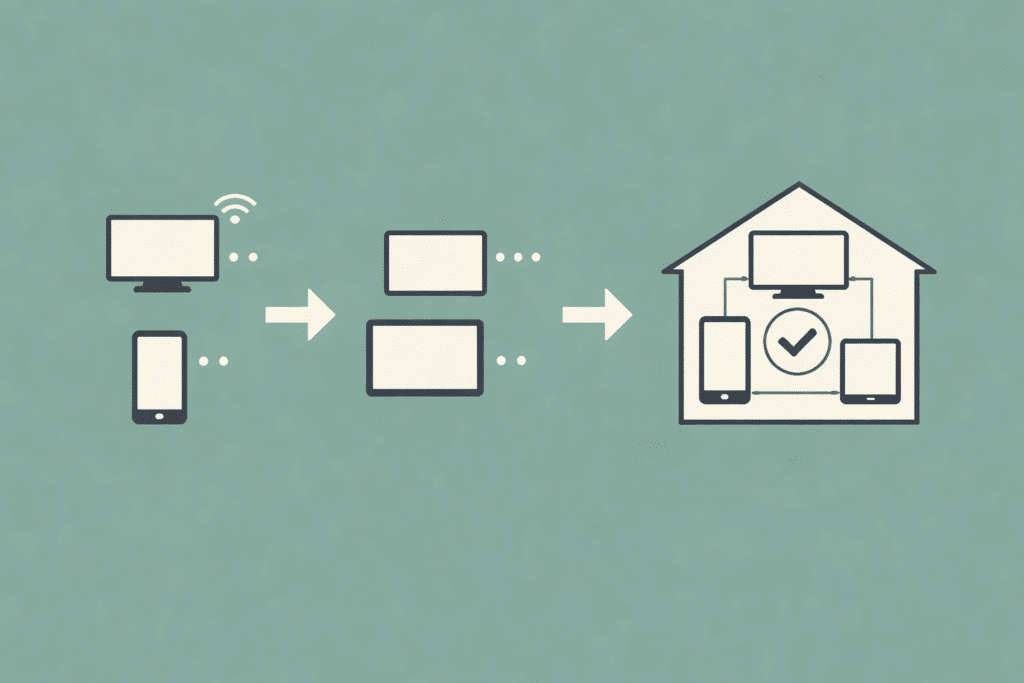
CTV advertising has reached the point where simply being present isn’t enough. Many marketers and agencies already buy glass on a screen, but the results often feel broad, inconsistent, or hard to explain. You see impressions and completion rates, but you’re not always sure you’re reaching the right households, or why one campaign works while another one stalls.
Most CTV performance issues are not caused by media execution, but by how the audience is defined.
This Q&A explores those questions and shows how measurement and household attributes can lead to more consistent performance and more realistic expectations.
Q: Why am I not seeing the results I expected from my CTV advertising campaigns?
A: If your CTV results are not where you want them to be, it is worth taking a close look at the data behind your targeting. Many buyers assume CTV data is deterministic and precise. In reality, household identity in streaming is messy, which reduces audience accuracy. Device graphs miss people, IDs break, and platforms often deliver broad, generalized audiences. The result is reach without relevance.
It helps to reframe the problem at the audience level. Household targeting is powerful, but the industry has not fully understood its challenges or its opportunities. The core challenge is data quality. The opportunities are significant: understanding your audience before you target, validating household need before you spend, and using the same dataset for planning, activation, and measurement across every channel.
Q: What does “household targeting” really mean in CTV advertising, and why does it vary so much across platforms?
A: Much of what the industry calls household targeting is based on device or app-level stitching. Platforms try to estimate who belongs in a household by linking Smart TVs, streaming apps, and mobile devices. This breaks down when someone changes a device, updates an operating system, uses a different app, or streams outside the home. It may look like household targeting, but underneath it behaves like an approximation.
A more robust approach defines household targeting differently. It is ID-free and based on real-world household characteristics. We describe households using stable, census-based attributes that do not rely on cookies, MAIDs, device IDs, or cross-device graphs. These reflect modeled household characteristics derived from verified data sources, such as lifecycle stage, income level, home ownership, and presence of children, rather than being inferred from device-level behavior alone.
Q: How can I improve the performance of my CTV campaigns?
A: The most effective way to improve CTV performance is to understand who converts before you target anyone. This becomes possible with a measurement-first approach. By placing our tag on your website, you can see the likely household attributes of the people who visit and convert. This includes factors such as home ownership, household income, number of cars, education level, presence of children, and many others.
Once you know which types of households convert at the highest rates, you can use that insight to build more accurate CTV audiences. This effectively validates which audience types represent real demand, not just observed interest. This shifts CTV advertising from assumption toward evidence, grounding intent in a stable audience definition. You move from hoping the right households see your ads to focusing on the households your data has already confirmed are most likely to take action.
Q: What should I expect from high-quality CTV data?
A: High-quality CTV data should be household-based, privacy-safe, and stable. It should describe real household characteristics that do not change every time a device is replaced or an app is updated. It should support planning and activation across channels rather than operate in isolated silos. You should expect consistency, transparency, and a clear explanation of what the data represents.
What you should not expect is one-to-one identity or personal profiles. CTV often functions as a household channel rather than an individual channel, and the data should reflect that reality.
Q: How do I know the CTV data I buy is actually useful?
A: Useful CTV data has four traits. It is based on households rather than devices. It remains stable across platforms, apps, and environments. It does not depend on cookies, MAIDs, or stitched IDs. And it reflects real household characteristics rather than inferred interests or behavioral guesses.
If your current CTV data relies on identity stitching, cross-device graphs, or lists of device IDs, it is more likely to behave unpredictably. If it is grounded in census-based household attributes, it is more likely to perform consistently and scale reliably.
Q: How can Digiseg data help me improve the results of my CTV campaign?
A: Digiseg improves CTV performance by grounding your targeting in the reality of who converts. Our tag reveals the likely household characteristics associated with your customers. Once you know which types of households drive your business, you can reach similar households across CTV, digital, and mobile with much greater accuracy.
The same audience definition can then be applied across channels without being reinterpreted in each environment.
Instead of targeting devices that may or may not belong to the people you care about, you target households based on verified attributes. The same dataset supports planning, activation, and measurement, which helps bring consistency to every stage of the campaign and improves the quality of your CTV data overall.
This Q&A outlines a clearer path for improving CTV advertising performance. When household data is accurate, privacy-safe, and measured before targeting, CTV becomes more predictable and more effective.